Financial Modeling Language
FML is a declarative, human-readable source form for financial planning models — variables, dimensions, links and formulas as plain text files that round-trip losslessly with a live planning platform.
Financial Modeling Language (FML) is the source form for a financial
planning model: the model's variables, dimension links, and formulas declared as plain
text instead of trapped as clicks inside a tool. A .fml file states a
variable's business grain, its links to other dimensions, and the formula that computes
it — nothing else lives outside the file. This is model as code: the file
is the model, and the planning platform is the runtime that executes it.
# dimensions need no declaration — naming one in a grain is enough:
# Clients, SKUs, Brands, Years, Months

# relations — the FK graph that does the roll-ups
link SKUs -> Brands

# variables — each declares its grain, then its formula

"Quantity IN"    { Clients, SKUs, Years, Months }
"Unit Price IN"  { SKUs, Years, Months }
"Revenue OUT"    { Clients, SKUs, Years, Months }
                 = "Quantity IN" * "Unit Price IN"   @readonly
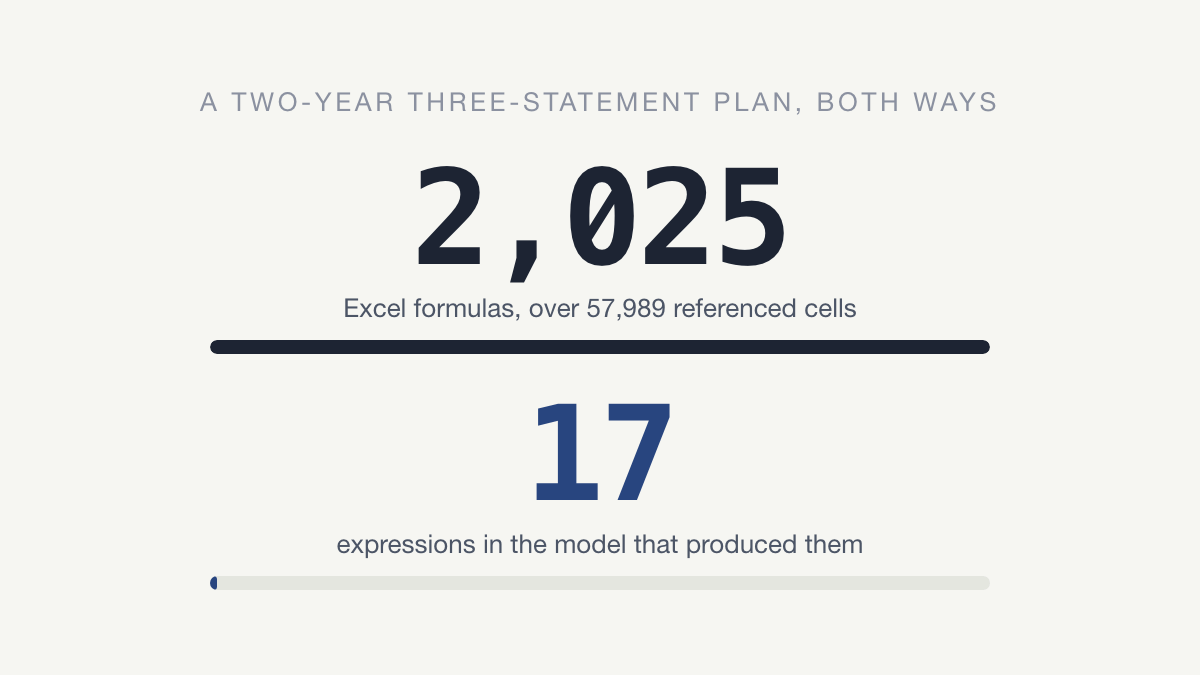
The generator that wrote it runs in your browser: change
the chart of accounts or the horizon and it rewrites both sides, then hands you the
.fml and the .xlsx to keep.
Why it exists
Each of these traces back to the same gap: the model has no source form. FML closes it directly, one pair at a time:
- No diff
- Reviewable diffs — a model change reads like a code change, before it lands.
- No history of why
- Versioned reasons — the commit message carries the decision, next to the change itself.
- No tests
- Pinned regression totals — last quarter's reconciled numbers, checked before a refactor.
- Invisible to AI agents
- Agents read the model and propose changes as diffs, under human review.
The precedent
FML is not a novel idea — it's the same "as code" pattern that already played out, on schedule, in every other engineering discipline:
| Discipline | Its "as code" moment | Since |
|---|---|---|
| Infrastructure | Terraform — servers and networks declared in text, applied by plan | 2014 |
| Data transformation | dbt — pipelines as versioned SQL, tested in CI | 2016 |
| BI semantics | LookML — the metric layer as reviewable code | 2013 |
| BI semantics, mainstream | Power BI TMDL — semantic models as git-diffable text | 2024 |
| Financial planning | — still clicking — | ? |
"Revenue OUT" { Clients, SKUs, Years, Months }- = "Quantity IN" * "Unit Price IN"+ = "Quantity IN" * "Unit Price IN" * (1 - "Discount % IN")+ # CR-142: contract discounts move from post-hoc adjustment into the model
That diff is a review, an audit trail, and an explanation — in six lines. Try producing any one of the three from screenshots.
FAQ
- Is FML a programming language?
- No — it's the declarative statements finance already thinks in (Revenue = Quantity × Price, at a stated grain), not a general-purpose language. Reading it matters far more than writing it.
- Does the planning UI go away?
- No. The grid, the sheets, and the drill-downs all stay exactly as they are. FML is the record underneath what you click — not a replacement for the planner’s experience.
- What lives in a .fml file?
- A variable's business grain, its links to other dimensions, the formula that computes it, and directives like @readonly that describe how a value behaves — plus the harness: the business context attached to the numbers, from the assumptions behind a target to the reason a driver changed, so an AI reading the model can interpret the figures, not just recompute them.
- Where is the full specification?
- FML 1.0 is published as a public git repository: the grammar, the evaluation rules, the function reference and the modelling guide, versioned, so the language has one citable source that a diff can change rather than a description spread across articles. It comes with conformance tests an engine can run. Where this page and the specification differ, the specification is the reference. FML 1.0 on GitHub.
- How do AI agents use FML?
- An agent reads the whole model as text, proposes a change as a diff, validates it against the dimension graph before anything touches the live system, and a human approves before it lands.
- Who builds FML?
- FML is the language behind Farseer models — farseer.com — introduced and documented on this site by Farseer's co-founder.